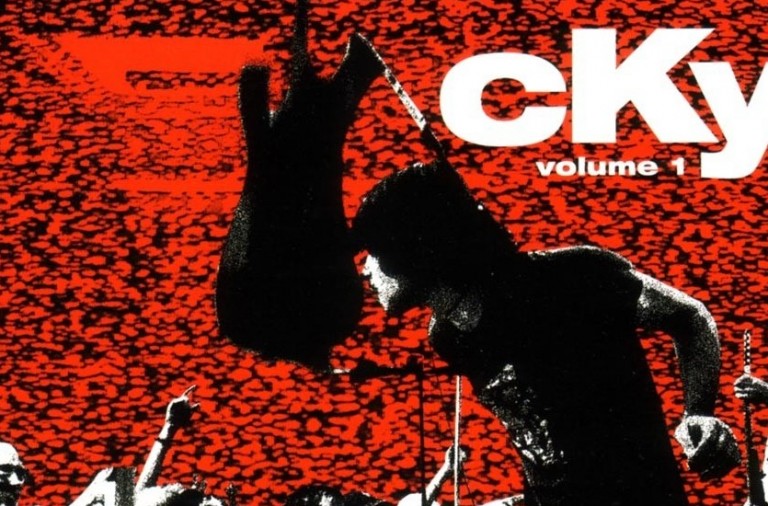
CKY’s Volume 1: Skateboards, Psychopomps and Depression
It is hard to describe something as diverse and as influential as the American rock band CKY, an abreviation of the band’s original name: Camp Kill Yourself, as they have been branded as a lot of genres. From skater rock to heavy metal to progressive post-grunge, the vast and diverse catalog of the band has led them to many different venues and a multitude of well acclaimed and viral albums and songs. While originally tied with the other CKY crew, the skateboard/xtreme sports professionals, they have since left the skater identity behind to find their own unique sound and image, one that scream fear and danger, but also loneliness and self discovery, all while telling different stories in vivid and sordid details. So let’s take a look at this band, and at their first album, originally self titled, but since rebranded as Volume 1.
CKY was, at the time of Vol 1 up until 2015, made up of Deron Miller, lead vocalist and rhythm guitarist, Chad i Guttensberg, lead guitarist and producer, and Jess Margera, drummer. While at first associated with the CKY crew of skating, and the Jackass team of extreme sports, as Jess’s brother Bam was a part of both, the truth is that the skating crew took its name from the band, who was made up of Jess and Deron at first. They found success since their first single, 96 quite bitter beings, as it was used in the CKY videos. But their sounds didn’t really solidify until Chad’s entry into the band, mixing and adding produced beats to the raw demos, which led up to their first full length album: Volume 1.
Released in 1999, Volume 1 was mostly written by Deron Miller, as it was mostly finished before Chad got into the band as a sound engineer. Performed by the trio plus bassist Ryan Bruni, who helped the band before in their live appearances before they formed CKY. The album is noticeably long for a debut album of the time, especially in the genre of skater/trash rock, as it had an original run time of 52 minutes, while the remastered release boasts a 1 hour 27 minutes run time. It is also notable for having many of the band’s most known songs, such as 96 Quite Bitter Beings and Halfway House, and the former song being the start of the band’s multi-album storyline about Hellview, which extended in their second album Infiltrate Destroy Rebuild, and their 5th album Carver City. The album has been rereleased on 2010, featuring more songs, live versions, and audio remasters for most of the songs. We will take a deep dive into 4 songs from the album, each tackling a different take on a specific subject, and even could be categorized as being from different genres. 96 Quite Bitter Beings, the album opener, The Human Drive in Hi-Fi, the fast paced heart of the album, Promiscuous Daughter, a song about shame and desire, and Sara’s Mask, the emotional climax of the album.
Let’s start from the beginning. 96 Quite Bitter Beings is not just the opening track for CKY’s first album, but also the first single they had ever released, making it the first introduction the world had to the new vision and ambition of the trio from Pelsyvania. And how does the song start? With a strong and heavy riff, seeping with power and anger. The riff goes along the whole duration of the song, except during an interval of total chaos before the second chorus, all of which represent the facade of stability, one that gets thrown off by the sudden banging and distortion, just as the story gets more and more distorted by itself. The song tells of a story, the first in a trilogy of songs that talk about the town of Hellview and its residents. The song talks of two people driving through the woods, going towards the town of Hellview, where their friend disappeared. They soon realize that the town, with the eponymous 96 residents, is a place that no one leaves alive, and that they value their routine life in a way that anyone that disturbs their peace leaves in pieces. As the song states: “They’ve deleted all the tourists at the bottom of the lake.
And not one supports the cause to leave the blood stay in the veins.”
Anyone who steps into the town and stays there long enough is bound to be ripped to shreds, and thus an escape is necessary. But the narrator finds the exit sealed, flooded due to a storm, and the song ends with the lamentation of the narrator:”Footprints giving clue to where we are
All we ever wanted was an answer
Civilized are close but way too far
All we ever wanted…”
An answer is all that they wanted, but all they found is desolation and death. The story continues on the next album, in the song Escape From Hellview, as the narrator goes through the woods, trying to run away from the residents and hopefully find a reason for his madness. The song was used in many videos during the early 2000s, leading to its, and the band’s, viral success. The song was also later referenced by the band itself in the title of their 3rd album, An Answer can be Found, calling back to the last lines of the song. And while the song tells a story, the rest of the album doesn’t continue it, but rather tackles other issues that were plaguing the times.
One such issue, which is still important today, was the issue of media, technology and its consumption. And that is the message that is in the core of the song The Human Drive in Hi-Fi.
The song starts with a fast and slick guitar and synth riff, one that is unusual in the realm of metal, going in at a 5/4 signature, and keeping the rhythm in an arpeggio that doesn’t descend until the last bridge. The drums, being in a 7/4 tempo, makes them sound slightly faster than the guitar, but slower than the synth, making the song have a futuristic, but also archaic, feeling. The song features Bruni in backup vocals, along with Chad on the synth and the guitar, with Devon singing in two different tones during the chorus, and another one during the bridge, making this song be divided into three parts: verses, choruses and the bridge.
The song’s first verse sets up the story and idea of the song.
“I Can’t deny it all my life
It’s the token of my life
Something you would try
For the best in the obscene
Just look on the TV screen
To pass away the while”
The lyrics make it obvious that it is about TV. Everyone has a TV, everyone watches it, and everyone enjoys it. Or do they? It’s been there all our lives, and watching it became a routine. It has become a part of our society, of our community, and also the only way we pass time. And yet, it still shows everything our community deems obscene: Kissing, drugs, relationships, death, murder..etc Done to attract us, of course, but it doesn’t filter anything away, as most of it truly is useless.
“It doesn’t matter if you’re
Red, black, or in the sack
I’ve got my grip, I’ve got a hold
Nothing ties one down like prime time in hi-fi
But now its getting old”
The “Red black or in the sack” is a very interesting line to take. At first glance, one might think it’s saying that TV has affected us all, that no matter who you are or what ethnicity you are, TV already controls your life, and through it , the media controls what you think and what you feel. But it goes deeper than that. The colors that were depicted: Red and Black, both refer to minorities. Red being the Natives and Black being blacks, TV makes us desensitized from their problems and from their ideals. Black culture is not defined by black people anymore, the majority only knows black people from the depiction the media gives them, and that gives the media a hold on their lives. Same goes for the native Americans, and any other group. Once the TV shows you, it has it’s grip around your identity and your life. As for ‘in the sack”, that is a euphymism for both sex and death. TV controls the view people have on relationships, on love , on what is acceptable and what is not. If the TV starts demonizing same sex relatioonships, then they will become a sham. If the TV says that having a non-interracial family is racist, then the view shifts. The TV makes the world see what it wants, and to help with that, depictions of death and violence, and the constant reports of shooting and deaths etc make people see death as a normal occurrence, and as such, people become drones, seeing people the media wants them to see as evil as just statistics when they die, while crying for the death of people who might have not deserved it. Nothing ties one down like prime time, as in no one can stop the influence, as people are drawn to see the prime time shows and series, where anything and everything can be sent and programed into targeted audiences.The last line gives some hope, as the ‘now its getting old’ means that the influence of tv is slowing down, with the advent of the internet and technology, but it shows fear that the higher ups know that already and have already started infecting the new advances.
The second verse goes like this:
“The fierce power switching on the
Ripe adolescent light
Terminates in five
The people standing in the lines
Have seen the film a million times
With a pocket full of dimes”
Basically, the teenage rebellion inside is killed, with the power terminating it so that we can become social animals following the whims and the orders of what the media tells. The people stand in the lines to see a movie, even though they have seen something like it a million times. Hollywood is what is criticized in this part, as a repeat of storylines, of themes and messages have made them stale. But people still fall for it, as the power of the media is too great for any to escape. Advertizing, trailers, interviews and castings are all made so that people would come and pay their money, fueling the success of the industry and paving the way for more of the same stories and the same actors to do it all again, this time with stronger and more aggressive marketing. Hollywood has retorted to rebooting movies or making the same movie all over again, and , just like the TV in the first verse, is abusing its power to create a vast majority that supports its every whim and thought.
“And so unless it is for free
You’ll spin the country on its side
To be intensified”
For free here is less about the monetary value and more about the message. Should the media and the film industry not cease its abuse of power and its flagrant usage of messaging to influence the minds of people into going a certain route or taking certain sides, then it will undoubtedly divide the country, which will only lead to problems politically and civilly, which will make them be more aggressive to get even more people on their side, intensifying the hatred and struggle, and leading into a perpetual war. This is sadly something that has happened, years after the song warned about it. The world is undoubtedly broken nowadays, and it is only getting worse due to the inability of the media to stay unbiased, only adding fuel to the flame.
As for the chorus, it goes like this:
“People stop and stare
Here, there, and everywhere
They’ve got the blueprints for life
They keep pretending
The world is ending
You’ll be fictionized”
It enforces the ideas discussed in the verses; People don’t know what they watch, and are just staring at whatever is given to them. And that gives the media the blueprints for life, the power to model the world in any shape or form they want. They use fear to enforce their ideas, a us vs them mentality, claiming that the world will end and civilization will be destroyed if the other side wins. People in the end are fictionized, as in live in a world where everything they know is fiction, as reality and imagination are no longer different. The enemy in the movie is the enemy in real life, and the fight is never over; You’ll be fictionized for the future generations, who will also be conscripted in a mind war that will last until the end of days.
The bridge, which features a different guitar riff and no synth , goes as follows:
It’s on this TV
It’s on that TV
It’s on your TV
It’s on my TV
It’s on his TV
It’s on her TV
It’s on this TV
It’s on your TV screen
It is a simple warning. It’s on the tv. It’s not real. But it’s on everyone’s TV, and so it must be real. If a rumour is spread enough, it becomes truth, and the truth fades into nothingness. If everyone sees the same lie, then the media wins, once it becomes the sole source of information, everything it tells you is the truth.
The song ends with a reprise of the chorus:
And You’ll keep pretending
That the world is ending
You’ll be fictionized
In the end, we ourselves have found comfort in the lie.
We pretend, and we choose to believe. And if we continue on this path of blindly following and never fact-checking, we will keep pretending, and we will be stuck in a fiction that will never end. The song warns of dangers and problems that might have been bad in the late 90s, but are significantly more prominent in our current time. Give it some thought, how much fact checking do you take part in? Have you been fictionized, or is ripe adolescent light still shining through?
Speaking of adolescence and people being mistreated and made to follow rules they don’t believe in, let’s move on to our next song: Promiscuous Daughter.
Starting loud, strong and with an explosive riff, My Promiscuous Daughter is towards the end of the album. The first line, as with most of the song, is short and to the point. “I caught my daughter giving head to my brother”.
Rage, anger, confusion and disturbance can all be felt from the start. The previous line is repeated 8 times in the song, while its other variation, “What can be done with my promiscuous daughter” is repeated 6 times, and the last variation “ I can’t be down with my promiscuous daughter” repeated twice.
This dichotomy is necessary to understand the underlying message in the song. Each variation has half its repetitions before a bridge and the other half after it, offering us a way to see the lyrics as two different people analyzing the situation, or , more probably, the same person seeing the situation from two different sides. As the song starts, the narrator has discovered his daughter sleeping with his brother, an act of incest which leads them, understandably, to freak out. The repetition, as the first 4 times are the openers to the song, is also split into two: the first couplet that is accompanied by the loud guitar, and the second one where the riff is less prominent but the drums are heavier. The first couplet here shows surprise, while the second shows disgust, as one would be if they discover such an act. The song then goes to the first lyrical bridge:
A lame domestic fame
I call it graphic pain
Some say to innovate
I don’t need that again
So here, we can disseminate four parts, the fame, the pain, the innovation and the repetition. The fame shows the first thing the narrator thought of: the family name. If people know, then infamy will follow. A lame fame that will make them a black sheep in the face of the neighbors. Second is pain, as in the pain the shame will bring them. Or maybe the pain the narrator things to inflict upon his daughter. A graphic pain to showcase that this will not blow over. Innovation, in the way of making excuses, is needed for this situation. Finding a new way to deal with this problem. Throwing the daughter out will lead to tarnishing the family name. Letting this become news means shame, and so an excuse is needed for whatever punishment, or “pain” was inflicted. As for repetition, then it shows that this might not be the first time this has happened. Was it an act of rebellion? Or was it something else?
We move on to the second verse/bridge before we take a look at the derivatives of the chorus. The second part goes as follows
“Not just the family name
Unveiled but don’t complain
Either one can feel ashamed…
I don’t need that again
Some say to innovate
It rained on my parade
A resolution on New Year’s Day
Clean up my train of thought”
It again shows the concern for the family name, for who should take the blame, and for the running of the general mood of the day. The verse gives some context: It was New Years, so it was a family dinner, and as such this must have been the worst time for a scandal.
The other line that is important is “ what can be done with my …” and “ i cant be down with my..”
They both give the same idea: the daughter is the one blamed here, and the narrator is looking for punishments, and even maybe thinking of sleeping with her himself. Here, we can see the idea of the song crystalize. The narrator does not think about the situation in any other angle except the one where his daughter is at fault and that she needs to be punished. The song subtly shows that the daughter isn’t to blame, and that it was probably the fault of her uncle, who might have been grooming her for years. The repetition, the usage of “ again” , and the “clean up my train of thought”show that this is not an isolated incident, but rather something that has been happening all around. The narrator, most likely, knew about this abuse, but either could not believe is as there was no evidence at first, or chose not to believe it and stick to his imaginary image of his daughter, who, once caught in the act of being forced to do a sexual activity, is punished. The daughter is seen as promiscuous, as a deviant seductress, but the song nudges the listener unto the path that it is not her fault, and that her entourage is making her out to be the villain.
The punishment in the final lines sound like the narrator thinking about using the same thing she things she enjoys as a way to make her stop; sex. And while the song itself is not based on any specific story, things like this happen most of the time.
All around the world, underage girls get raped by family members.Be it uncles, brothers, cousins or what have you, a high percentage of girls who grow up in either poor or unsupervised families tend to be sexually abused or assaulted by a close relative. And yet, most of them do not speak out about it, out of fear of being reprimanded by their own parents. Many who come forwards with their stories of rape either get descridited as being delusional or being sexual deviants looking for an escape from their own mistakes. And this has not changed much from the days of the Volume 1 release. People are still abused and taken advantage of every single day, and if they don’t come forward with it and be ostracized for seeking shelter, they are caught and then deemed to be succubi looking to dishonor an honest person. Society seems to have a general distrust for young people, especially when they speak up against the authority, be it the adults, the government, or, most importantly, themselves. This leads them towards a path of self destruction, and as news break out of their misdeeds, the world responds by bullying them into a corner, where they find two answers: become a part of this cold world, or leave it forever.
Which leads us into our final song , Sara’s Mask, a song about deformation, sadness, and guiding yourself into death.
to be continued
 Kingdoms of Fire